Total Pageviews

Showing posts with label botany. Show all posts

Saturday, June 18, 2016

Destination: Mighty Mac Part Two


The Tunnel of Trees' official designation is Michigan Highway 119, or M119. It snakes along the Lake Michigan coastline from the city of Petosky around Little Traverse Bay and through the quaint and bustling village of Harbor Springs to Cross Village. This was the second leg of our Mighty Mac trip. As we were on a mission we did not spend time in either Petosky or Harbor Springs. Petosky was a post two Summers ago and Harbor no longer has my favorite coffee shop so we did not stop. Harbor is a better Fall or Early Spring trip anyway. Too much traffic on this stop to oggle things. So we cruised through downtown to get to our real destination... the Tunnel.

Left bar: M119 literally snakes along the coast, taking this section at high speed is ludacris, Top row: the flock, cement plant in the distance, the barns of the sheep farm, Middle left and right: a variety of canopy density, Top Right:imitating the tropics, bottom: Good Hart General Store, Good Hart Post Office and another S-curve.

You can see from the photo collage that it is aptly, if somewhat unimaginatively, named. Over twenty miles of woodlands with intertwined canopy along twisting roads beckons the daytripper. When you pass the country club it won't be long before you come upon one of the most bucolic scenes that will take you breath away. None of us expected to find an operational sheep farm. This farm's rolling pastures sits atop an upper cliff dotted with deciduous and coniferous groves overlooking Little Traverse Bay. In the far distance, through the early afternoon haze the Charlevoix cement factory sits like a strange lighthouse.

I could have sat here all day. The road in this section is lined with thick banks of vetch and the view is just stunning. But this is just the beginning of the trip, there are still many miles of tunnel til the end. And it is an amazing drive. For the most part, the woodland is as dense as any forest, allowing one to imagine to be just about anywhere. It is quiet easy to imagine what it must have been like in Northern Michigan before the lumberman came and sheared the hills bare. For much of the stretch there are very few houses and it is even easier in these places to imagine what the Native Tribes saw as they lived here day to day for generations. That gets a bit depressing when one things on how the European Immigrants usurped the indigenous people.

As we drove through here I was lost in thought as to how similar this forest is to the pictures I have seen of the German forests. Though I doubt that these trees have regrown sufficiently to mimic the giants of the German forests which inspire tales of dread and caution or could be the muses behind Tolkein's Ents. Groot maybe, but not the Ents. I do imagine that when my immigrant ancestors came they thought of their homes in the Schwartzwald, Grunewald, Thüringer Wald and the Odenwald of lore. A more apt name for this forested area here would be Gleichenwald: similar to the German forest. But then we would have to change a lot of signs and maps.

The Tunnel of Trees Heritage Trail, as it is formally called, follows the Lake Michigan shoreline closely. It isn't all wonders and imagination however. A sharp bend at Terpenning Road, known colloquially as The Devil's Elbow,  is a treacherous curve that begins M119's close association with the coast line. This is not at all a road to drive at great speeds. Doing so may cause you to have a closer association with a hulking oak than you would like. The road sits atop the edge of the bluffs overlooking the big lake some 100-280 feet below the road. While it is impossible to see Lake Michigan for much of the 20 miles, there is a stretch after the Elbow beyond imagining.
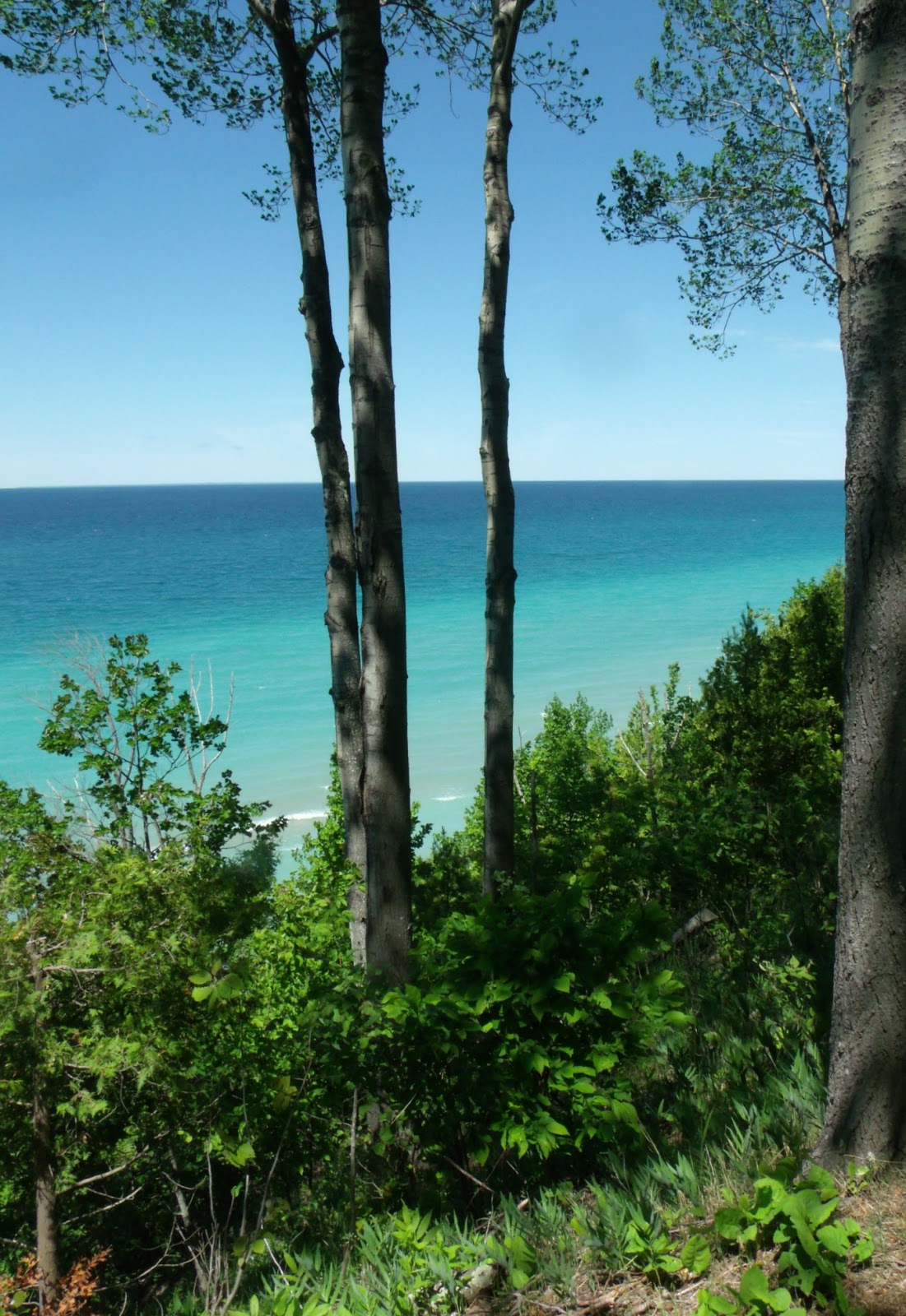
At the height of the bluffs, where the boundary between road and water is thin, the trees break to reveal stunning water vistas. You see a glimpse of such in the collage above. While this area is lined with residential homes and it is considered rude to stop and spend a day in someone's private park. There should be little harm in standing on the shoulder for photos. From this section one could imagine oneself in Greece or on some tropical isle. Lake Michigan stretches far out to the sapphire horizon, reinforcing its inland sea image. From this vantage point it is difficult to guess the terrain of the cliff face or how deep the beach at the bottom might be. There may be no beach at all.

It is somewhere along this passage that my housemate supposed actor Viggo Mortenson spent a Summer taking pictures and restoring an old cottage. She has lots of sidebar information in her head about stuff like that. And this was a really good trip for having conversations about nothing that were also not about crappy somethings and sad somethings that we can not change. Even in a car the natural beauty of our countryside and distant wilds has a calming effect. The mind wanders around the things we are curious about and not so much the things that we worry about. It could be the deep and lush greens of the canopy and the ground vegetation or it could be the vibrant jeweled blues of the water that calms. Which ever it is, whatever the combination of influences is, we need it. Nature heals the senses which I believe can calm a weary mind. Even in a car, whizzing along at 40 miles an hour.

After Horseshoe Bend we plunge into darkness again. The canopy becomes dense with some of the deepest shades of green imaginable. The temperature is a little cooler here too. On the day we were here, there were enough differing shades of green to make an Irishman smile. Almost no traffic that day either so having the road mostly to ourselves we didn't worry about getting pushed by tailgaters or squished by oncoming traffic.

Fewer homes sit in the dense forest. Fewer mailboxes mar pictures. And the conversation flows along meandering tangents until animals cross our paths. While it was the wrong time of day to see deer, there were a good many birds playing chicken with the car. The dappled light is soothing enough to make for some sleepy backseat passengers.

The road continues on like this until you get to the sleepy little town of Good Hart, the half way point on this long and winding road. Good Hart is a small place consisting of a General Store and Post Office maintained in picture postcard perfection. It is a great place for a potty break and to grab a bite to eat if you haven't packed a lunch like we did. The General Store stocks it's own specialty foods on the shelf as well as the expected standbys and has a deli. While we did not partake of the deli offerings, the homemade cookies near the register made mouths water. We were back on the trail once we refreshed ourselves.

The stretch between Good Hart and Cross Village begins to diversify with some sandy dunes breaking into the forest. The road becomes much more difficult to traverse as potholes and crumbling shoulders make for interesting conditions. M119 does not have a center yellow line down its middle as other state roads do and the fog line, the white line on the side, is worn. There is very little reason to travel this road at night and I wouldn't suggest trying. Even though it is a perfect Dark Sky site, the canopy is so thick over much of the road that you wouldn't really be able to see stars. This stretch also reminds me of the Pierce Stocking Drive in the Sleeping Bear Dunes National Forest on Leelanau Peninsula. The coast bluffs and the winds that rise from it probably have a lot to do with that as it makes difficult living conditions for all but the most hardy of species.

Cross Village bursts out of nowhere. The topography and vegetation give little warning that you are about to come to a village. You are in the trees and then you are in the village. Cross Village is much larger than Good Hart, It boasts a couple of successful restaurants, church, a couple of retailers and a public park. It is here in the public park that I found one of my bears. One side of the bear is a map of the Heritage Trail area and the other depicts Native American life along the lake shore here.

Sometime we will go again to sample the food here. People drive hundreds of miles to eat at the Legs Inn and I would like to taste what I am missing.

The Tunnel of Trees ends here in Cross Village. You have the option of going east to join US 31 and get back to civilization or continuing north. We opted for the northern route, erroneously thinking that we might get to the bridge along the entire tip of the mit*.Somewhere north of Cross Village the Wilderness State Park's 10,000+ acres is in the way. You have to veer east to the tiny one building town of Bliss to continue northward. Along the way there is more rolling farm land, some wetlands, a few more dunes, and some picturesque farms. Emmet county has very little flat surface to it. The whole thing is like a rollercoaster. No wonder my cousins enjoyed it so much.

We did get a bit turned around and were helped by a friendly FedEx driver. But once we were on our way it was smooth going into Mackinaw City.


*Tip of the Mit is the local vernacular for the region of Northern Lower Michigan encompassing Antrim, Otsego, Monmorency, Alpena, Emmet, Cheboygan and Presque Isle counties. They are the northern most counties of northern lower Michigan which is notable for its mitten shape.

Wednesday, April 29, 2015

Love Latin

This is not a Cottonwood. No one mentioned that
trees age with wrinkles in the identification part
of the descriptions. The smooth bark is at the top
of the tree, about 6 years of growth. The fissures
are at the base. I will make a new botanical later
when I am less mad at the internet. 
I'm not sure why I love Latin so much. It isn't the conjugating and the pronunciation because that stuff just kills me. What I love about Latin is that it makes things clear from an identification perspective. All of the world's organic bits are ordered and cataloged with Latin names to make sense of how things beget, or are related to, other things. When I started working in the rubber stamp industry, I fell in love with Personal Stamp Exchange's images. They incorporated Latin identification in the portraits of flowers and animals. And I think that is where I fell in love with the aesthetic. They took that aesthetic from Victorian botanical prints and illustrations such as this  that I found on Pintrest. I also found this gem which shares a similar aesthetic in my stamp collection.

I don't really stamp anymore. Not in the last few years because of all the things that we have already covered in the blog. But my collection is calling me. I miss the weight of the wood printing blocks in my hand, the squishy tap of the ink as it lands on the rubber and the smell of hot embossing powder. But I digress. I wanted to talk about the Latin. I am a language geek. I am a glyph geek. I love to see how people communicate and I like to play with what we know.  So it is little wonder to me that I am beginning to incorporate what I loved about my work in the past with the work that I am doing now. Part of me wonders why it is taking so long to incorporate the elements... but that is for another post.

One of my goals is to build a library of stock images that I have taken. It will give me a purpose for the images I collect while I am improving my photography skills. And it will give us something interesting to look at while perusing this little ole blog. That is what I am doing today while the sun is still not cooperating. I want to make botanical cards with the pictures that I am taking. But to do that, I need to know the common names of the things that I am taking pictures of. That should be easy. But it isn't.

For a long time now, I thought that the tree that was outside of the house was an Aspen. That is what the homeowner said. But it isn't. Aspens and Birches have smooth papery bark. The tree that is outside of the house has fissures in it, like a maple. So it can not be an aspen. How do you confuse the two? Turns out is is pretty easy. Thank you Latin ID! But no thanks to everyone who's opinions on the subject differ. It would seem that taxonomy is not the exacting science that we would wish it was.

Aspens, Birches and Cottonwoods are very similar. They all have catkins, rhomboid leaves and belong to the same sub-kingdom of angiosperms (flowering plants). It gets a little messy for me in the phylum and class because no one speaks the language of botany that I grew up with. And no one agrees what the distinctions are. Aspens and birches look a lot alike in the bark department. Silvery white, smooth and papery with similar leaves. But they are of different orders. Aspens are Malpighiales and Birches are Fagales. I don't know why the two should look so much alike if they belong to two different orders. It is weird and makes me question if Rivinus knew what he was talking about since they aren't even in the same Family! But the main difference that I can see is that the Malpighiale needs a male and a female tree to reproduce and the Fagale has both sexes on the same tree.

Aspens and Cottonwoods belong to the order of Malpighiales and the Family of Salicaceae. They are dioecious, meaning that the male and female reproductive organs are on two different trees. The catkins (flower clusters) are red for males and green for females. The cottonwood differs from the Aspen in that it has a shallowly fissured bark like maples and oaks and not the smooth papery bark of the Aspen. The leaves are nearly identical which I think is what throws everyone off. Our park is mixed with smooth barked Aspen leaves and rough barked Aspen leaves. Which if I weren't looking so intently at the birds I wouldn't have noticed the trees that they were living in.

There are a lot of details to consider in deciding a plant's taxonomy. And I am glad it is not my job. It is hard enough trying to figure these things out with a field guide and clear pictures. I am fairly confident I know what this tree is. It leaks nectar which is also another trait of the Malpighiales; they require bees to pollinate.This also explains why there are so many wasps that like to nest on the house. And why does all of this even matter?

Because I love the aesthetic of old botanical prints and I want to make a bunch of digital versions now that I am getting used to how my camera really works. All of this research and agony for art that started with an observation. Ugh.... life was so much simpler when I was distracting myself with fishing and outdoor pursuits with the BF. Now that I am outdoors on my own I do not really want to venture too far afield.